From 21 to 25 September 2026, Erlangen (Germany) hosted the 14th CIRP Conference on Photonic Technologies (LANE 2026). LANE is one of the leading international meetings on laser-based manufacturing, bringing together research centres, universities and industry to discuss the latest advances in photonic technologies for production.
On 22 September, in the session “Laser Processes – Battery & E-Mobility”, Girolamo Mincuzzi, Senior R&D Engineer at ALPhANOV gave the industrial talk Cutting and texturing of new generation battery: a test bench for high power femtosecond laser, co-authored with Marc Faucon and Aurélien Sikora. The presentation featured results linked to the GIGAGREEN project, alongside Politecnico di Torino and CIC energiGUNE.
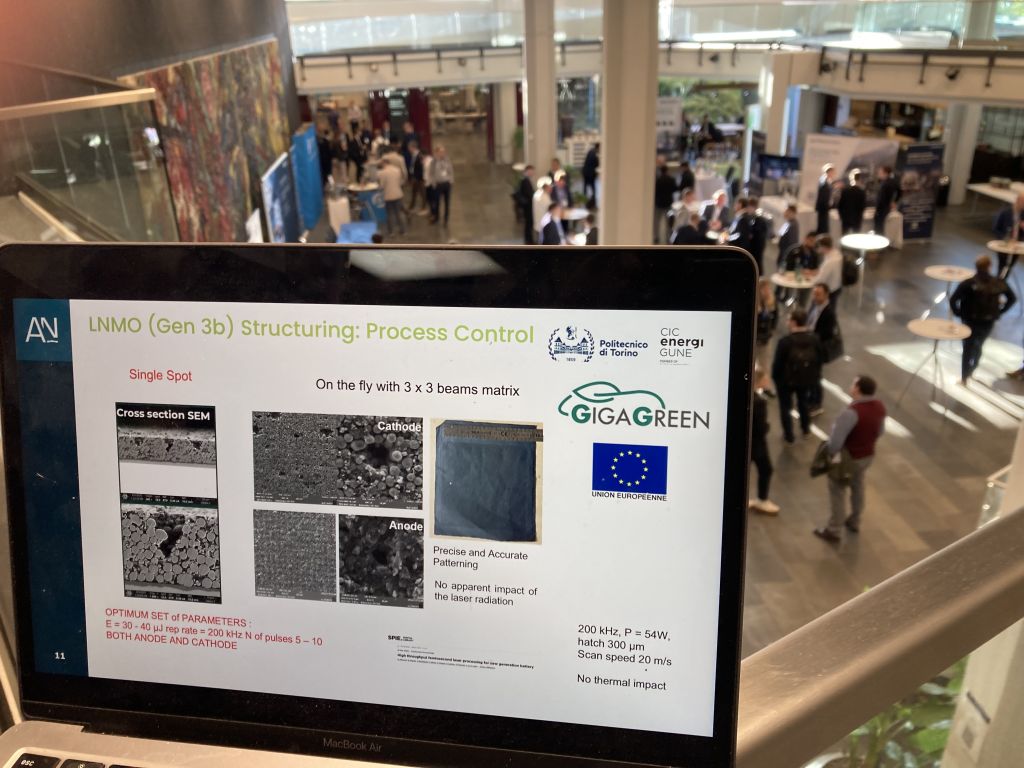
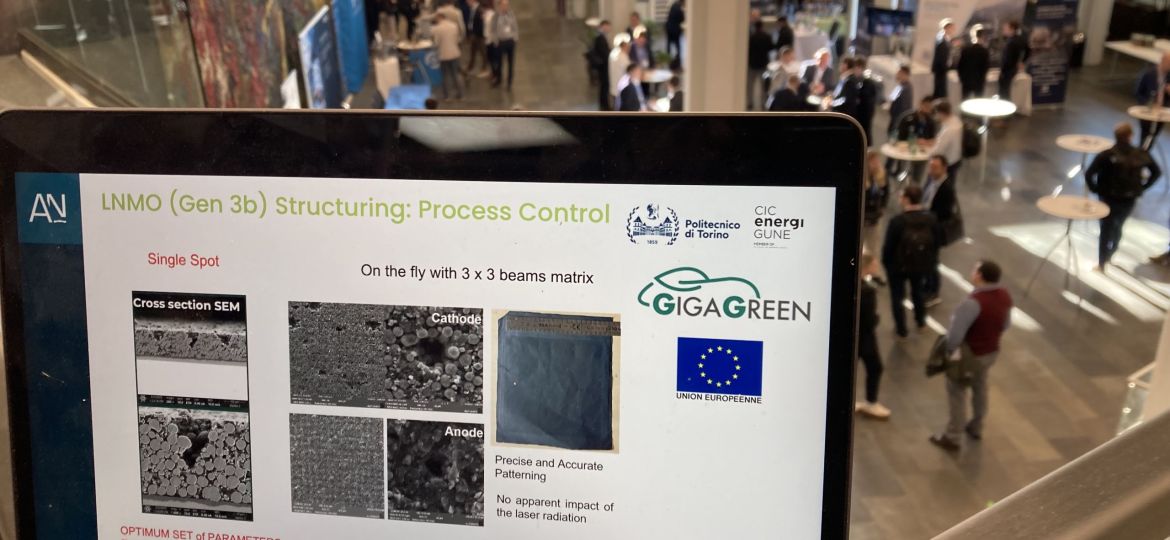
The talk addressed a key challenge for the next generation of lithium-ion batteries: how to structure electrodes precisely and quickly, without damaging the active material. One focus was the laser structuring of LNMO (Gen 3b) electrodes. The team compared single-spot processing with an “on-the-fly” approach using a 3 × 3 beam matrix, which splits the laser into nine beams to process the surface in parallel and increase throughput.
Cross-section SEM images of both cathode and anode showed precise and accurate patterning, with no apparent impact of the laser radiation on the surrounding material and no thermal damage. The team identified an optimum parameter window valid for both anode and cathode: pulse energies of 30–40 µJ at a repetition rate of 200 kHz, with 5 to 10 pulses. The on-the-fly process ran at 54 W average power, a 300 µm hatch distance and a scan speed of 20 m/s. These are promising figures for moving towards industrial production rates.
Laser structuring of electrodes can improve how batteries perform. It can speed up electrolyte wetting and improve fast-charging behaviour. It also fits within the GIGAGREEN vision of more efficient and sustainable electrode manufacturing for European gigafactories. Presenting these results at LANE 2026 gave the project visibility among the international laser-processing community, and it opened the door to new exchanges with equipment suppliers and research groups working on e-mobility.