The GIGAGREEN project has made significant progress in optimising materials for greener manufacturing processes, aiming to replace current organic-based formulations. The selected materials for the project, including cathode and anode active materials, electrolyte, and binder systems, have been validated at laboratory scale and are ready for integration into pouch cell prototypes. The successful completion of this milestone marks the definition of a consolidated and scalable material set for further optimisation and pilot-scale activities.
A Co-free LNMO blend was chosen as the cathode active material, which, combined with a water-based and fluorine-free binder developed for the project, demonstrated full compatibility with roll-to-roll processing. On the anode side, a Si/C composite, also processable using water-based and fluorine-free binders, was selected for its superior capacity control and cycling stability.
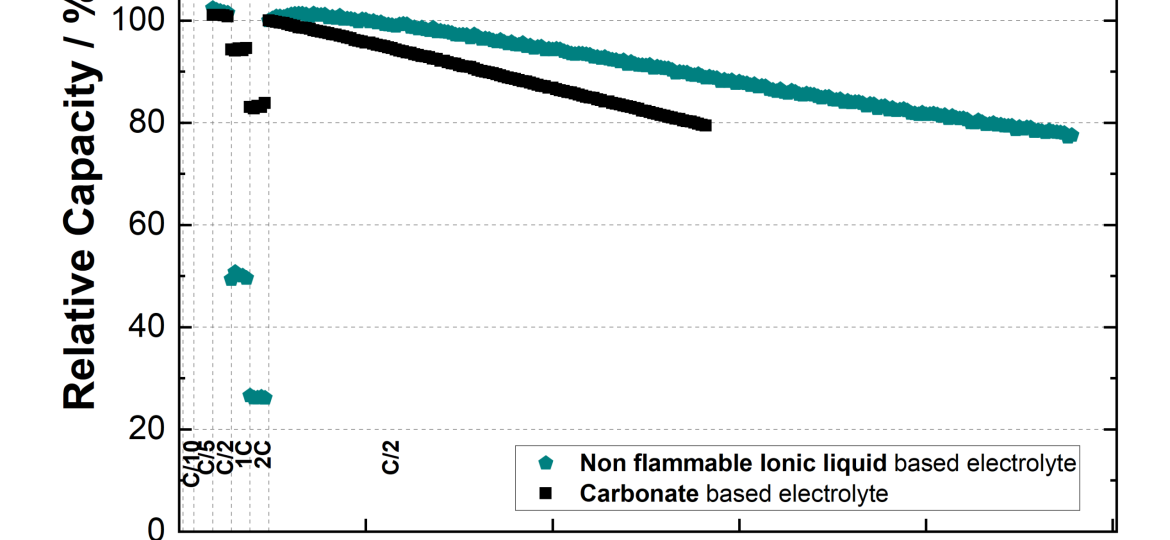
The ionic-liquid-based electrolyte, optimised with various ionic liquids, salt concentrations, and additives, demonstrated good performance in terms of capacity, rate capability, and long-term cycling.
In addition to water-based electrode production, dry processing using hot pressing was also explored. The focus here was on selecting fluorine-free binders, which enabled electrode production without the need for organic solvents.
Overall, all selected materials align with environmental, sustainability and cost criteria, including F-free binders, aqueous or dry processing of electrodes, and the possibility of electrolyte recovery for recycling. These materials are expected to be compatible with pilot-scale manufacturing and TRL progression, setting the stage for further optimisation, including electrode scaling and pouch cell production.